SurveyMonkey Pricing 2026: Full Plan Breakdown and Honest Review
Affiliate Disclosure: This article contains affiliate links. If you sign up through our link, we may earn a commission at no extra cost to you. We only recommend tools we genuinely believe provide value. Read our full disclaimer
SurveyMonkey Pricing 2026: Full Plan Breakdown and Honest Review of the Survey Software
SurveyMonkey pricing is one of the most flexible in the survey software category. Specifically, plans start free for basic surveys with up to 10 questions. Moreover, paid tiers scale based on response volume, advanced features, and team size. This complete SurveyMonkey pricing guide breaks down every plan, every feature, and every limitation. As a result, you can decide whether SurveyMonkey is the right survey tool for your business in 2026. Try SurveyMonkey Free →
SurveyMonkey Pricing Guide: What Is SurveyMonkey and What Are You Paying For?
📋 The Customer Feedback Problem SurveyMonkey Solves
Before breaking down SurveyMonkey pricing, it helps to understand the problem the platform was built to solve. Specifically, businesses need structured feedback from customers, employees, and prospects to make confident decisions. Moreover, manually collecting feedback through email or interviews scales poorly across hundreds or thousands of respondents.
For growing businesses, this creates a real bottleneck. Specifically, decision-making slows when feedback collection takes weeks rather than days. Additionally, response data scattered across emails and spreadsheets becomes impossible to analyze meaningfully. Consequently, businesses need survey software that automates collection, distribution, and analysis without requiring research expertise.
💡 What SurveyMonkey Does Differently
SurveyMonkey launched in 1999 as one of the first online survey tools. Specifically, the platform pioneered self-service survey creation accessible to non-researchers. Moreover, SurveyMonkey became the industry standard for surveys over the following two decades. As a result, the platform consistently delivers feature breadth and integration depth that newer competitors struggle to match.
Today, SurveyMonkey serves over 17 million users across 350,000 organizations globally. Furthermore, the platform handles billions of survey responses annually across customer feedback, employee engagement, market research, and academic studies. Additionally, the parent company Momentive expanded SurveyMonkey beyond pure surveys into market research and customer experience platforms through 2024-2026. Therefore, understanding SurveyMonkey pricing tiers is essential before committing to any survey tool in 2026.
🔗 SurveyMonkey in Your Marketing Stack
SurveyMonkey pairs naturally with other tools in modern marketing and customer experience stacks. For example, our Brevo review covers the leading email marketing platform that distributes SurveyMonkey surveys to subscribers. Similarly, our ManyChat review covers the chatbot platform that captures conversational feedback before survey deployment. Additionally, our AdCreative.ai review covers the AI ad creative tool that uses survey insights to inform high-converting campaigns.
Collect Smarter Feedback with SurveyMonkey
Join 17M+ users using SurveyMonkey for customer feedback, employee engagement, and market research.
Why SurveyMonkey Is the Best Survey Software for Most Businesses in 2026
SurveyMonkey is consistently rated among the leading survey software platforms. Specifically, the platform competes directly with Typeform, Qualtrics, Google Forms, and Microsoft Forms. Here is what makes SurveyMonkey genuinely stand out in the online survey tool category:
📚 Industry-Leading Question Library
SurveyMonkey offers the largest pre-built question library among survey software platforms. Specifically, the question bank includes 2,000+ professionally written questions across customer satisfaction, employee engagement, market research, and academic categories. Moreover, every question includes methodology guidance for proper survey design. As a result, non-researchers create methodologically sound surveys without research training.
Additionally, the question library is continuously updated based on response data from billions of surveys. Therefore, SurveyMonkey users get questions proven to deliver actionable response data. Consequently, this is why marketing, HR, and product teams consistently choose SurveyMonkey over more aesthetic-focused competitors.
🌍 Universal Survey Recognition
SurveyMonkey holds unique brand recognition in the survey category. Specifically, respondents recognize SurveyMonkey-branded surveys immediately, increasing response rates compared to lesser-known platforms. Moreover, this name recognition matters significantly when collecting feedback from external customers or research panels. Therefore, businesses prioritizing response rates benefit from SurveyMonkey’s market position.
SurveyMonkey Pricing Justification: Survey Tools for Business Use Cases
Survey tools for business serve specific use cases beyond academic research. Specifically, SurveyMonkey covers every major business survey need professionally. Here are the use cases where SurveyMonkey genuinely delivers ROI:
📊 Customer Satisfaction and NPS
Customer satisfaction surveys remain SurveyMonkey’s most common use case. Specifically, businesses run Net Promoter Score (NPS), Customer Satisfaction (CSAT), and Customer Effort Score (CES) surveys regularly. Moreover, SurveyMonkey’s pre-built NPS templates include benchmark data comparing your scores against industry averages. As a result, businesses understand their customer satisfaction performance contextually rather than in isolation.
👥 Employee Engagement and 360 Reviews
Employee engagement is the second most common SurveyMonkey use case. Specifically, HR teams use SurveyMonkey for engagement pulse surveys, exit interviews, and 360-degree performance reviews. Moreover, anonymous response options encourage honest feedback that managers cannot otherwise collect. Additionally, SurveyMonkey’s enterprise features handle the data privacy requirements HR teams need. Therefore, this is why HR departments at large organizations consistently choose SurveyMonkey Enterprise for sensitive employee feedback collection.
🎯 Market Research and Product Validation
Market research teams use SurveyMonkey for product validation, pricing studies, and competitive analysis. Specifically, businesses test new product concepts with target audiences before committing development resources. Moreover, SurveyMonkey’s research-grade methodology ensures statistically meaningful results rather than directional opinions. As a result, product decisions get backed by real data rather than internal assumptions.
🎓 Education and Academic Research
Education institutions use SurveyMonkey heavily for course evaluations, alumni research, and academic studies. Specifically, the platform’s discount programs serve students and academic institutions affordably. Moreover, IRB-compliant features handle research ethics requirements properly. Consequently, SurveyMonkey remains the dominant survey platform in higher education globally.
SurveyMonkey Pricing Plan Features: Full Breakdown for 2026
Here is every major feature in this SurveyMonkey review. Moreover, each description includes honest detail on what works well and where genuine limitations exist:
🎨 Survey Building
Drag-and-Drop Survey Builder
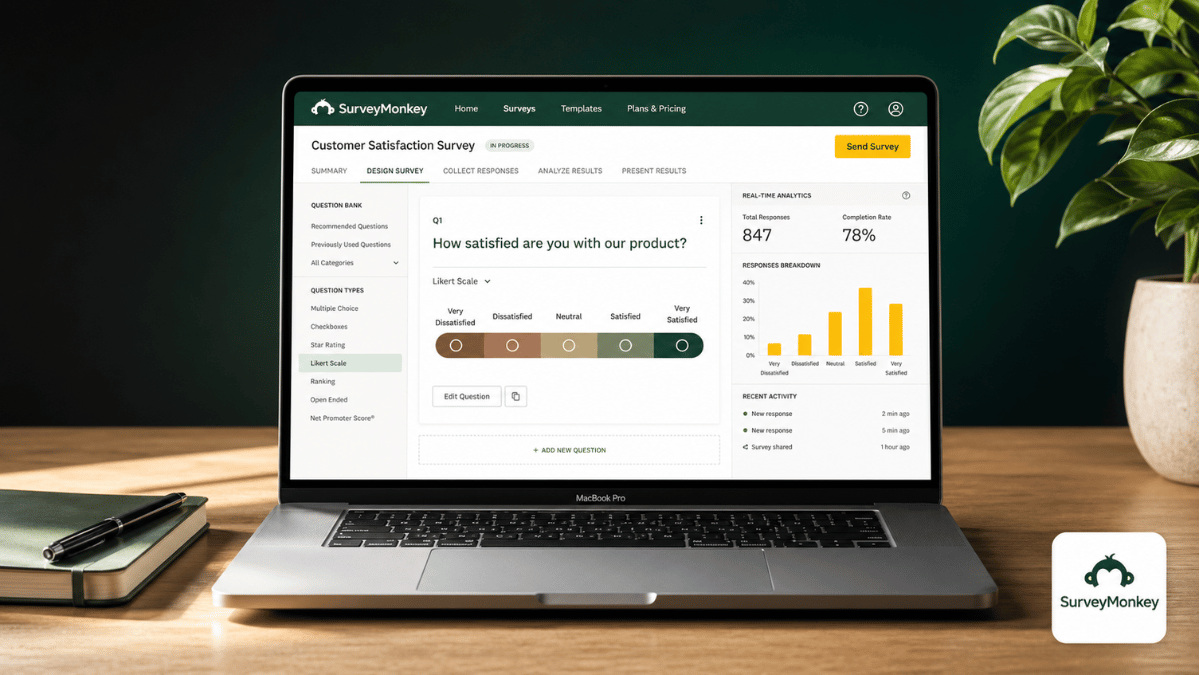
SurveyMonkey’s drag-and-drop builder makes survey creation accessible to non-researchers. Specifically, the editor includes 15+ question types including multiple choice, ranking, matrix, and Likert scale formats. Moreover, conditional logic routes respondents through different question paths based on previous answers. As a result, surveys feel personalized while collecting structured data. Additionally, mobile-responsive design ensures surveys work across devices automatically. Try the SurveyMonkey survey builder directly.
Question Library and Templates
SurveyMonkey offers 2,000+ pre-written questions and 250+ survey templates. Specifically, templates cover customer satisfaction, employee engagement, event feedback, market research, and academic studies. Moreover, every template includes methodology notes explaining when and how to use specific question types. As a result, non-researchers create professionally designed surveys without survey design expertise. Consequently, this dramatically reduces time to launch new surveys.
Skip Logic and Branching
Advanced logic features adapt surveys to individual respondents. Specifically, skip logic routes respondents past irrelevant questions based on previous answers. Moreover, branching logic creates entirely different question paths for different respondent segments. Additionally, piping inserts previous answers into later questions for personalization. As a result, surveys feel conversational while collecting precise data. However, advanced logic features require paid plans.
Multi-Language Support
Surveys support 50+ languages natively. Specifically, SurveyMonkey handles translation, formatting, and right-to-left languages automatically. Moreover, multi-language surveys collect responses across global audiences in one survey instance. As a result, international research studies run on a single platform rather than requiring multiple language-specific tools. Therefore, global brands save significant time on international research deployments.
📤 Distribution and Collection
Email and Link Distribution
SurveyMonkey distributes surveys through email invitations, direct links, and embedded forms. Specifically, email campaigns track individual respondent completion and response data. Moreover, anonymous links collect responses without identifying respondents. Additionally, embedded surveys work directly inside websites and applications. As a result, businesses choose distribution methods matching their privacy and tracking requirements.
SMS and QR Code Distribution
Mobile-first distribution channels include SMS invitations and QR codes. Specifically, QR codes work excellently for in-store feedback, event surveys, and printed materials. Moreover, SMS distribution reaches respondents through preferred mobile channels. Additionally, both channels deliver higher response rates than email for younger demographics. Therefore, businesses targeting mobile-first audiences benefit from these distribution options.
Website Widget Integration
SurveyMonkey embeds surveys directly into websites through widgets. Specifically, popup surveys collect feedback at specific user behaviors like exit intent or page completion. Moreover, embedded surveys feel native to the website rather than redirecting to external pages. As a result, response rates improve compared to external survey links. Consequently, this is critical for collecting in-context website feedback.
SurveyMonkey Audience
SurveyMonkey Audience provides access to a panel of 175 million pre-recruited respondents globally. Specifically, businesses target specific demographics, psychographics, or behaviors for paid research. Moreover, this eliminates the need to build research panels from scratch. Additionally, response data arrives within hours rather than weeks. However, audience access requires per-response pricing beyond standard plans.
📊 Analytics and Integrations
Real-Time Analytics
Real-time analytics process responses as they arrive. Specifically, dashboards show response rates, completion rates, and answer distributions instantly. Moreover, cross-tabulation analyzes how different respondent segments answer the same questions. Additionally, sentiment analysis processes open-ended responses automatically. As a result, businesses identify patterns without exporting data to separate analysis tools.
Custom Reports and Exports
Custom reporting handles diverse stakeholder needs. Specifically, reports export to PDF, PowerPoint, Excel, and CSV formats. Moreover, branded report templates maintain visual consistency across stakeholder presentations. Additionally, scheduled reports automatically deliver updates to specific recipients. Consequently, busy executives stay informed without requesting custom analyses repeatedly.
100+ Native Integrations
SurveyMonkey integrates natively with 100+ business applications. Specifically, integrations cover Salesforce, HubSpot, Slack, Microsoft Teams, Zapier, and major analytics platforms. Moreover, response data flows automatically into CRMs, marketing automation, and BI tools. For teams building complete customer experience infrastructure, our guide on how to choose a CRM for a sales team covers the integration framework.
SurveyMonkey Pricing 2026: Every Plan Explained
SurveyMonkey pricing structures into multiple plan tiers for individuals and teams. Specifically, plans differ in response limits, advanced features, and team collaboration capabilities. Moreover, the pricing model serves everyone from solo researchers to enterprise organizations. Here is the complete SurveyMonkey pricing breakdown:
📊 Understanding SurveyMonkey’s Plan Structure
Before comparing plans, the SurveyMonkey pricing structure needs explanation. Specifically, SurveyMonkey offers Individual plans (single user) and Team plans (3+ users) with different features. Moreover, response limits scale upward across tiers from 100 monthly to unlimited. As a result, businesses match plans to their actual research volume rather than overpaying for unused capacity.
For example, a solo researcher running occasional customer feedback surveys may fit within the free plan or Individual Standard tier. In contrast, marketing teams running continuous research need Team Advantage or higher. Therefore, accurately estimating monthly response volume drives cost-effective plan selection. Additionally, annual billing delivers approximately 40% savings compared to monthly billing on most plans.
💵 SurveyMonkey Pricing Tiers Side-by-Side
Here is the side-by-side breakdown of every SurveyMonkey pricing plan. Specifically, plans range from Free for basic validation to Enterprise for organizations with complex compliance needs. Moreover, the most popular tier among DemoStack readers is Standard Monthly for individual researchers and Team Advantage for collaborative teams.
Free
$0/mo
10 questions · 25 responses
Includes basic survey creation with 10 questions per survey and 25 responses per survey. Moreover, the free plan covers 15 question types, basic templates, and core analytics. However, advanced features like skip logic, custom branding, and exports require paid plans. As a result, the free plan validates the platform with simple surveys before committing. Specifically, this works for occasional one-time surveys with small audiences.
Standard Monthly
$39/mo
Unlimited questions · 1,000 responses/mo
Includes everything in Free plus unlimited questions, 1,000 monthly responses, and full question type access. Moreover, skip logic, exports to multiple formats, and custom branding unlock. Additionally, basic integrations with Salesforce and Mailchimp become available. Consequently, this is the most popular plan for individual researchers and solo founders. Therefore, most individual users land here for full feature access.
👥 SurveyMonkey Pricing for Teams and Enterprise
For collaborative teams and large organizations, SurveyMonkey offers two additional pricing tiers. Specifically, Team Advantage suits departments and small research groups while Enterprise serves regulated industries with HIPAA, SSO, and unlimited response volumes.
Team Advantage
$25/user/mo
3 users minimum · Annual billing
Includes everything in Standard plus team collaboration, shared asset libraries, and centralized billing. Specifically, this plan suits marketing teams, HR departments, and small research groups. Moreover, advanced filtering, branded reports, and comparative analysis unlock. Additionally, priority email support reduces issue resolution times. Therefore, this is the right plan for serious team-based research operations.
Enterprise
Custom
Contact sales · Unlimited responses
Includes everything in Team Advantage plus SSO, advanced security controls, and dedicated customer success management. Specifically, custom response volumes, audit logs, and HIPAA compliance unlock. Moreover, advanced API access and custom integrations become available. Additionally, priority phone support and SLA guarantees apply. Therefore, this plan suits large organizations with complex compliance and integration requirements. Learn more about SurveyMonkey Enterprise.
🎯 SurveyMonkey Pricing Recommendation by Use Case
Which SurveyMonkey Plan Should You Choose?
For most teams evaluating SurveyMonkey pricing, the path is clear. First, try the Free plan to validate the platform with basic 10-question surveys. Then, choose Standard Monthly ($39/mo) for solo researchers needing unlimited questions and 1,000 monthly responses. Moreover, marketing and HR teams typically choose Team Advantage ($25/user/mo) for collaboration features. Finally, only choose Enterprise for SSO, HIPAA compliance, or unlimited response volumes. Start your free account at SurveyMonkey directly.
Build Better Surveys in Minutes
Free plan available. Choose from 250+ templates and 2,000+ pre-built questions backed by real research methodology.
SurveyMonkey Pricing Review: Honest Pros and Cons
This honest SurveyMonkey review section covers both genuine strengths and real limitations. Specifically, the analysis draws from 18,000+ verified user reviews across G2, Capterra, and TrustRadius:
✅ Where SurveyMonkey Delivers
- Industry-leading question library with 2,000+ professionally written questions
- 250+ pre-built survey templates across major business use cases
- Universal brand recognition increases respondent trust and response rates
- 15+ question types including matrix, ranking, and conditional logic
- Skip logic and branching create personalized respondent experiences
- Multi-language support across 50+ languages with right-to-left handling
- SurveyMonkey Audience provides 175M+ pre-recruited research panel
- 100+ native integrations with major business applications
- Real-time analytics with cross-tabulation and sentiment analysis
- SMS and QR code distribution channels beyond email
- Mobile-responsive design works automatically across all devices
- 17M+ users across 350,000 organizations proves global reliability
- 4.4/5 on G2 from 18,000+ verified reviews confirms genuine satisfaction
- HIPAA-compliant Enterprise tier serves regulated industries
❌ Where SurveyMonkey Falls Short
- Pricing higher than budget alternatives like Google Forms or Microsoft Forms
- Free plan response limit of 25 per survey feels restrictive for testing
- Survey design aesthetics less modern than Typeform’s conversational style
- Advanced features locked behind higher-tier plans aggressively
- Annual billing requirement on team plans reduces flexibility
- Customer support response times variable on Standard plans
- Reporting depth lighter than enterprise platforms like Qualtrics for advanced research
- Branded survey URLs require higher-tier plans
- Some integrations limited to higher pricing tiers unnecessarily
- Learning curve exists for advanced features like cross-tabulation
SurveyMonkey vs Typeform: Which Survey Tool Wins?
The SurveyMonkey vs Typeform comparison is the most common decision for businesses choosing between top survey tools. Specifically, both platforms target similar audiences but differ significantly in approach and features. Here is the honest side-by-side comparison:
| Feature | SurveyMonkey | Typeform | Google Forms | Qualtrics |
|---|---|---|---|---|
| Survey Style | Traditional grid | Conversational | Basic forms | Research-grade |
| Free Plan | ✓ 10 questions | ✓ 10 questions | Unlimited | ✗ |
| Starting Paid Price | $39/mo | $29/mo | Free | Custom |
| Question Types | 15+ types | 20+ types | 11 types | 50+ types |
| Question Library | 2,000+ questions | Limited | Limited | ✓ Strong |
| Skip Logic | ✓ Strong | ✓ Strong | Basic | ✓ Advanced |
| Brand Customization | Standard | Excellent | Basic | ✓ Strong |
| Integrations | 100+ native | 120+ native | Google Workspace | 50+ native |
| Research Panel Access | ✓ 175M panel | ✗ | ✗ | ✓ Strong |
| G2 Rating | 4.4/5 (18,000+) | 4.5/5 (700+) | 4.6/5 (40,000+) | 4.4/5 (5,000+) |
| Best For | Business surveys at scale | Conversational lead gen | Free basic surveys | Advanced research |
🎯 When SurveyMonkey Wins Over Typeform
SurveyMonkey wins on question library depth, integrations breadth, and research panel access. Specifically, SurveyMonkey’s 2,000+ pre-written questions outperform Typeform’s smaller library. Moreover, the SurveyMonkey Audience research panel of 175 million respondents has no Typeform equivalent. Additionally, SurveyMonkey’s brand recognition increases response rates for traditional business surveys. As a result, SurveyMonkey delivers better value for serious business research needs.
🎨 When Typeform Wins Over SurveyMonkey
Typeform wins on aesthetic design, conversational flow, and lead generation experiences. Specifically, Typeform’s one-question-at-a-time interface creates more engaging respondent experiences. Moreover, the modern visual design suits brands prioritizing aesthetics. Additionally, Typeform’s $29/mo starting price undercuts SurveyMonkey’s $39/mo entry tier. Therefore, businesses prioritizing modern design over feature breadth may prefer Typeform. Consequently, evaluate based on whether you need traditional research depth or modern lead generation experiences.
SurveyMonkey Alternatives: When to Choose a Different Survey Tool
SurveyMonkey is the right choice for most business survey needs in 2026. However, specific use cases are better served by SurveyMonkey alternatives. Here are the strongest alternatives worth considering:
🎨 Typeform — For Conversational Lead Generation
Typeform is the right SurveyMonkey alternative when conversational design matters more than research depth. Specifically, Typeform’s one-question-at-a-time interface creates engaging respondent experiences. Moreover, the modern aesthetic suits brands prioritizing visual design. However, Typeform lacks SurveyMonkey’s question library depth and research panel access. Therefore, choose Typeform for lead generation forms and SurveyMonkey for serious research.
📋 Google Forms — For Free Basic Surveys
Google Forms is the right SurveyMonkey alternative when budget is the primary constraint. Specifically, Google Forms is completely free with unlimited questions and responses. Moreover, the platform integrates seamlessly with Google Workspace tools like Sheets and Docs. However, Google Forms lacks advanced features like skip logic, branding, and integrations. Therefore, Google Forms suits internal surveys and basic feedback collection. In contrast, customer-facing research benefits from SurveyMonkey’s professional capabilities.
🔬 Qualtrics — For Advanced Research
Qualtrics is the right SurveyMonkey alternative when research methodology depth matters most. Specifically, Qualtrics offers 50+ question types and advanced statistical analysis features. Moreover, Qualtrics serves academic research and enterprise customer experience programs. However, Qualtrics requires significant investment and learning curve. Therefore, Qualtrics suits dedicated research organizations rather than general business surveys.
Pairing SurveyMonkey With Your Marketing Stack
SurveyMonkey handles the feedback collection side excellently. However, complete customer experience operations require additional tools for distribution, automation, and action on insights. Consequently, pairing SurveyMonkey with the right marketing stack creates closed-loop feedback workflows.
📧 Email Distribution and Automation
For distributing surveys to email subscribers, integration matters significantly. Specifically, our Brevo review covers the leading email marketing platform with native SurveyMonkey integration. Moreover, Brevo automates post-purchase surveys, NPS sequences, and follow-up campaigns based on survey responses. As a result, feedback collection becomes part of automated customer journeys. Therefore, this pairing creates continuous customer voice infrastructure rather than one-time surveys.
💬 Conversational Feedback Collection
Beyond traditional surveys, conversational feedback delivers higher response rates. Specifically, our ManyChat review covers the chatbot platform that captures Instagram and Messenger feedback in conversational formats. Moreover, ManyChat-collected feedback can route into SurveyMonkey for deeper structured surveys. As a result, businesses combine conversational and traditional survey methods for complete feedback coverage.
🎯 Survey Insights to Ad Creative
Survey insights inform smarter ad creative decisions. Specifically, our AdCreative.ai review covers the AI ad creative tool that benefits from customer survey data. Moreover, surveys reveal customer pain points, language patterns, and value perceptions that inform high-converting ad copy. Consequently, this combination creates evidence-based ad creative rather than assumption-based campaigns.
🏆 SurveyMonkey Review 2026: Our Final Verdict
Based on this complete SurveyMonkey review, SurveyMonkey earns a strong recommendation as one of the best survey software platforms for businesses in 2026. Specifically, the combination of question library depth, distribution options, and integration breadth makes it genuinely useful for serious feedback operations. Moreover, the universal brand recognition increases respondent trust and response rates compared to lesser-known competitors. Additionally, 17 million users across 350,000 organizations proves real-world reliability at scale.
⚠️ Honest Limitations to Consider
However, several limitations deserve attention. First, pricing runs higher than budget alternatives like Google Forms for basic needs. Second, survey aesthetics feel less modern than Typeform’s conversational design. Third, advanced features lock behind higher-tier plans aggressively. Nevertheless, for businesses prioritizing research depth, feature breadth, and proven respondent trust, SurveyMonkey delivers genuine value at every paid tier.
🎯 Recommended Path Forward
For most teams evaluating SurveyMonkey, the recommended path is clear. First, start with the Free plan to validate the platform with simple 10-question surveys. Then, upgrade to Standard Monthly at $39/mo for individual researchers needing unlimited questions. Moreover, marketing and HR teams typically choose Team Advantage at $25/user/mo for collaboration. Finally, only consider Enterprise when SSO, HIPAA compliance, or unlimited responses justify the cost. Consequently, this progression matches investment to actual research needs gradually.
✅ SurveyMonkey is right for you if:
- You need professional surveys backed by real research methodology
- You run customer feedback, NPS, or employee engagement programs
- You value brand recognition that increases respondent response rates
- You need access to 175M+ pre-recruited research panel
- You require HIPAA compliance, SSO, or enterprise security features
- You need 100+ integrations with major business applications
- You distribute surveys across email, SMS, QR codes, and embedded widgets
⚠️ Consider alternatives if:
- Modern conversational design matters more than research depth (choose Typeform)
- Budget is the primary constraint and Google Workspace is your stack (choose Google Forms)
- Advanced research methodology and statistical analysis are critical (choose Qualtrics)
- You only need internal team surveys with very basic features
- You prioritize aesthetic survey design above all else
Start Your SurveyMonkey Free Plan Today
Join 17M+ users using SurveyMonkey for customer feedback, employee engagement, and market research.
Free 10 questions · Standard from $39/mo · Team Advantage from $25/user/mo · Enterprise custom