Sender Review 2026: Best Mailchimp Alternative for Small Business
Affiliate Disclosure: This article contains affiliate links. If you sign up through our link, we may earn a commission at no extra cost to you. We only recommend tools we genuinely believe provide value. Read our full disclaimer
Sender Review 2026: The Best Mailchimp Alternative for Small Businesses on a Budget?
Mailchimp charges up to $45 a month for 500 subscribers. Sender gives you 2,500 subscribers and 15,000 emails every month completely free — with automation, segmentation, and SMS included. If you are looking for a Mailchimp alternative that does not punish you for growing your list, this honest Sender review covers everything you need to know before switching.
Sender Review: What Is Sender and Why Is It a Strong Mailchimp Alternative?
📧 The Mailchimp Problem
The search for a reliable Mailchimp alternative is one of the most common journeys in email marketing today. Mailchimp was the default choice for small businesses for years, but its pricing model has become increasingly difficult to justify as list sizes grow. Mailchimp’s free plan caps subscribers at 500 and monthly sends at 1,000 — limits so tight that most real businesses outgrow them within weeks of launching their first campaign. Once you upgrade, costs escalate quickly: $45 per month for just 1,500 contacts, $350 per month for 10,000. Consequently, thousands of businesses are actively searching for an email marketing alternative that delivers comparable functionality without the punishing price curve.
Sender was built specifically to address this gap. Founded in 2012 in Vilnius, Lithuania, Sender is an email and SMS marketing platform that serves over 180,000 businesses globally with a deliberate value proposition: give small businesses the full email marketing toolkit at a price point that makes sustainable use possible. The free forever plan offers 2,500 subscribers and 15,000 monthly emails — five times more generous than Mailchimp’s free tier — with automation, segmentation, signup forms, popups, and a landing page builder all included at no cost. For growing businesses caught between needing professional email tools and watching their software budget carefully, Sender is one of the most compelling options available in 2026.
🏢 Who Uses Sender?
Sender serves a broad cross-section of small to mid-sized businesses, with particular strength in e-commerce, retail, content creators, service businesses, and professional training organisations. The platform integrates natively with WordPress, WooCommerce, and Shopify, making it a natural fit for online store owners who need abandoned cart recovery, post-purchase sequences, and product promotion emails without paying Klaviyo-level prices. Furthermore, Sender’s SMS and MMS messaging capabilities on paid plans extend the platform beyond email into genuine multichannel marketing — a feature that most competitors in its price range do not offer as a native integration.
Start with Sender’s free plan — no credit card, no time limit
2,500 subscribers, 15,000 emails/month, full automation — completely free forever.
Who Is Sender Best For?
Sender delivers the strongest value for these specific business types based on our research and analysis of verified user reviews:
E-commerce Stores on WooCommerce or Shopify
Sender’s native integrations with WooCommerce and Shopify make it a strong email marketing choice for online stores. Abandoned cart recovery sequences, post-purchase follow-ups, and product promotion campaigns can all be set up within the platform without requiring third-party connectors. For small stores that find Klaviyo’s pricing out of reach and Mailchimp’s automation too limited on lower tiers, Sender hits a practical middle ground — professional e-commerce automation at a fraction of the cost.
Small Businesses Leaving Mailchimp
The most common Sender user profile in 2026 is a small business owner who has hit Mailchimp’s free plan limits and is evaluating alternatives before paying Mailchimp’s steep upgrade prices. Sender’s migration path is smooth — the platform accepts list imports, preserves segmentation structure, and the interface is clean enough that teams familiar with Mailchimp adapt quickly. Additionally, the feature parity on core functionality like automation workflows, templates, and reporting means there is no meaningful capability sacrifice when switching.
Startups and Early-Stage Businesses
For businesses in the early stages who need a professional email marketing tool but cannot justify significant monthly software costs, Sender’s free forever plan is genuinely one of the best starting points in the market. The 2,500 subscriber and 15,000 email monthly limits cover real business usage — not just a token sample — and every core feature including automation, popups, and landing pages is unlocked from day one. As the business grows, upgrading to paid plans is straightforward and affordable compared to the alternatives.
Businesses Wanting Email and SMS from One Platform
Sender includes native SMS and MMS messaging on Standard and Professional plans, allowing businesses to run email and text message marketing from a single platform with unified contact management and shared automation workflows. For businesses that currently pay separately for an email tool and an SMS platform, consolidating into Sender can reduce total cost and eliminate the operational complexity of managing two separate systems and keeping contact lists synchronised between them.
Newsletter Publishers and Content Creators
Content creators who publish regular newsletters to growing audiences find Sender’s pricing model particularly attractive because it scales affordably with list growth rather than triggering large price jumps at arbitrary subscriber thresholds. The drag-and-drop email builder produces clean, professional newsletter designs quickly, and the analytics provide the open rate, click rate, and engagement data needed to understand what content resonates with subscribers over time.
Sender Review: Full Feature Breakdown for 2026
Here is every major feature Sender offers, with honest detail on what works well and where limitations exist:
📧 Email Creation and Templates
Drag-and-Drop Email Builder
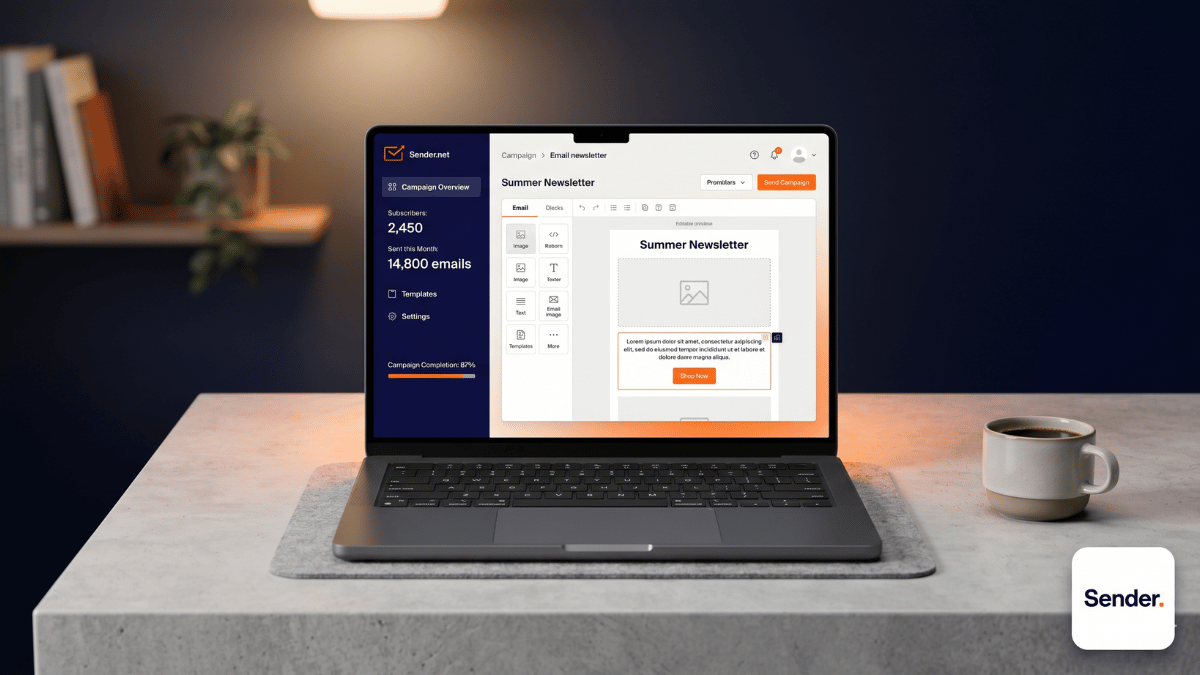
Sender’s email builder is consistently cited as one of the cleanest and most intuitive in the email marketing software category across G2, Capterra, and Trustpilot reviews. The drag-and-drop interface allows non-designers to build professional-looking emails quickly by placing content blocks — text, images, buttons, dividers, social links, and HTML sections — onto a canvas that renders correctly across desktop and mobile. Consequently, most users report going from blank canvas to a polished, sent campaign within 15 to 20 minutes on their first attempt. The builder includes a live preview so you can see exactly how the email looks on different device sizes before sending.
Email Templates Library
Sender provides a library of pre-built, mobile-responsive email templates covering the most common use cases: newsletters, promotional emails, product announcements, welcome sequences, abandoned cart recovery, and seasonal campaigns. Templates are professionally designed and fully customisable within the drag-and-drop editor. Some users note that the template selection is smaller than Mailchimp’s extensive library, but the quality of available designs is consistently rated as clean and professional rather than generic or outdated. For most small business sending needs, the template library is more than sufficient to get started immediately.
Mobile-Responsive Design
All Sender emails and templates are automatically mobile-responsive, meaning the layout adjusts correctly for smartphone screens without requiring separate mobile editing. Given that the majority of emails are now opened on mobile devices, this is a non-negotiable baseline — and Sender handles it reliably. The email preview tool shows both desktop and mobile rendering so you can verify the design before sending to your full list.
🤖 Email Automation
Automation Workflows
Sender includes visual automation workflow builder on all plans including the free tier — a significant competitive advantage over Mailchimp, which restricts automation to paid plans. Automation workflows are trigger-based sequences that send emails automatically based on subscriber actions or conditions: new subscriber welcome sequences, birthday emails, purchase follow-ups, re-engagement campaigns for inactive subscribers, and link click follow-ups. The workflow builder uses a visual flowchart interface where you place trigger nodes, condition branches, wait steps, and email send nodes. Additionally, premade automation templates for the most common sequences are available, significantly reducing setup time for standard workflows like welcome series and abandoned cart recovery.
E-commerce Automations
For businesses on WooCommerce or Shopify, Sender supports abandoned cart recovery sequences, post-purchase thank you emails, product review request automations, and win-back campaigns for customers who have not purchased recently. These e-commerce automations are available through the native integrations with WooCommerce and Shopify, and they represent some of the highest ROI automations available to online store owners — abandoned cart emails alone typically recover 5 to 15% of otherwise lost revenue according to industry benchmarks. Consequently, for e-commerce businesses, activating these automations essentially makes Sender’s cost self-funding from recovered sales alone.
Transactional Emails
Sender supports transactional email sending — the system-triggered emails like order confirmations, password resets, shipping notifications, and account welcome emails that are sent in direct response to a user action. Transactional email capability is included on all plans, making Sender a unified solution for both marketing campaigns and operational emails without requiring a separate transactional email service like SendGrid or Postmark for the transactional layer. This is particularly valuable for small e-commerce businesses that want to keep all email types under one platform and one billing account.
📊 List Management and Segmentation
Segmentation
Sender includes list segmentation tools that allow you to create targeted audience segments based on subscriber data, behaviour, and engagement history. Segments can be built using conditions like subscriber location, signup source, email open history, link click history, purchase history (for e-commerce integrations), and custom field values. Sending targeted campaigns to specific segments consistently outperforms sending to your full list — higher open rates, better click rates, and fewer unsubscribes. Segmentation is available on the free plan, which is notably generous compared to platforms that restrict it to paid tiers.
Signup Forms and Popups
Sender includes a form builder for creating embedded signup forms and popup forms that can be placed on any website to capture new subscribers. Form types include inline forms, popup overlays, slide-in forms, and floating bars. Exit-intent popups — which trigger when a visitor moves their cursor toward the browser close button — are included and can significantly improve list growth rates without disrupting the visitor experience for engaged readers. All form types are customisable to match your brand colours and messaging, and completed signups flow directly into your Sender contact list and trigger any associated welcome automation.
Landing Page Builder
Sender includes a basic landing page builder for creating standalone pages to promote lead magnets, course signups, webinar registrations, or product launches. Landing pages are hosted on Sender’s infrastructure and can be connected to a custom domain on paid plans. While the landing page builder is not as advanced as dedicated tools like Leadpages, it covers the fundamental use case of creating a simple, functional page to capture subscribers or promote an offer without needing a separate tool. For Sender users who are already on the free plan, having a landing page builder included at zero cost is genuinely useful.
📱 SMS Marketing
Native SMS and MMS Messaging
Sender includes SMS and MMS messaging on Standard and Professional plans, allowing businesses to send text message campaigns and transactional SMS from the same platform as their email marketing. SMS campaigns can be standalone broadcasts or integrated into automation workflows alongside email steps, creating true multichannel sequences where a subscriber receives an email followed by an SMS reminder if they have not opened within a defined timeframe. Free SMS credits are included on the Professional plan, making it the strongest tier for businesses with active SMS programs. For businesses currently paying separately for an SMS platform, this consolidation alone can justify the upgrade from the free plan.
Analytics and Reporting
Sender provides campaign analytics covering open rates, click rates, bounce rates, unsubscribe rates, and geographic performance data. The reporting dashboard gives a clear picture of how individual campaigns performed and how your list engagement trends over time. Some power users note that the analytics are more basic than advanced platforms like ActiveCampaign or HubSpot — there is no predictive analytics, revenue attribution, or deep behavioural scoring — but for the majority of small business email marketing needs, the core metrics dashboard provides everything needed to optimise campaigns and understand what content resonates with your audience.
Sender Pricing 2026: Every Plan Explained
Sender uses a volume-based pricing model where paid plans scale by subscriber count and monthly send volume. Here is exactly what you get at each tier:
Free Forever
$0/mo
No credit card · No time limit
2,500 subscribers, 15,000 emails/month, full automation workflows, segmentation, signup forms and popups, landing page builder, transactional emails, analytics. Includes Sender branding on emails. The most generous free email marketing plan available in 2026 — covers real business usage, not just a trial.
Standard
from $10/mo
From 1,000 subscribers · 12x monthly send volume
Everything in Free plus: no Sender branding, SMS and MMS messaging, multi-user access, increased sending limits (12x subscriber count per month). Best for growing businesses that have outgrown the free plan’s subscriber limit and need to remove Sender branding for a professional appearance.
Professional
from $20/mo
From 1,000 subscribers · 24x monthly send volume
Everything in Standard plus: free SMS and MMS credits, animated countdown timers, advanced automation features, dedicated IP address, review blocks for social proof, priority support. Sending volume doubles to 24x subscriber count per month — ideal for automation-heavy programs and frequent broadcast senders.
Enterprise
Custom
Contact sales for pricing
Unlimited subscribers, unlimited emails, free SMS and MMS, dedicated IP, dedicated success manager, advanced user permissions, SSO (SAML v2), activity logs for auditing, phone support, and a Service Level Agreement. Designed for large organisations with high-volume requirements and compliance needs.
How Sender’s Pricing Compares to Mailchimp at Real Usage Levels
At 2,500 subscribers: Sender = $0. Mailchimp = ~$45/month. At 5,000 subscribers: Sender Standard = ~$15/month. Mailchimp = ~$75/month. At 10,000 subscribers: Sender Standard = ~$32/month. Mailchimp = ~$135/month. The pricing gap compounds significantly as your list grows. Over 12 months at 10,000 subscribers, switching from Mailchimp to Sender saves approximately $1,200 per year while retaining all core email marketing functionality. Start for free at join.sender.net/demostack.
Switch from Mailchimp to Sender — start free today
No credit card required. Import your list, build your first campaign, and send — all for free.
Sender Review: Honest Pros and Cons
✅ What Sender Does Well
- Most generous free plan in email marketing — 2,500 subscribers and 15,000 emails/month forever
- Full automation workflows included on free plan — Mailchimp charges for this
- Drag-and-drop builder is consistently rated as intuitive and fast — campaigns live in under 20 minutes
- Native WooCommerce and Shopify integrations with abandoned cart automation
- SMS and MMS marketing included on paid plans — genuine multichannel from one platform
- Transactional emails supported on all plans — no need for a separate transactional service
- Signup forms, popups, and landing page builder included at no extra cost
- Pricing scales affordably — significantly cheaper than Mailchimp at every list size above 500
- Solid deliverability — emails consistently land in inboxes rather than spam folders per user reports
- GDPR compliant with EU-based infrastructure — important for European businesses
- 4.7/5 on G2 with 210 verified reviews, FrontRunner 2026 status on Software Advice
- No contracts, no setup fees, cancel or change plans anytime
❌ Where Sender Falls Short
- Fewer third-party integrations than Mailchimp — 300+ vs a more limited native connector set
- Free plan emails include Sender branding — requires Standard plan to remove
- Analytics are basic compared to advanced platforms like ActiveCampaign or HubSpot
- No built-in CRM — requires a separate tool or Zapier connection for contact management beyond email
- Not suitable for cold email outreach or purchased lists — strict permission-based sending policy
- Advanced automation logic branching is less sophisticated than enterprise tools
- Template library smaller than Mailchimp’s — though quality is solid for available designs
- Interface available in English, Lithuanian, Polish, and Spanish only
Sender vs Mailchimp and Other Mailchimp Alternatives
If you are actively searching for a Mailchimp alternative, here is the direct comparison that matters:
| Feature | Sender | Mailchimp | Brevo | MailerLite |
|---|---|---|---|---|
| Free Plan Subscribers | 2,500 | 500 | Unlimited contacts | 1,000 |
| Free Plan Emails/Month | 15,000 | 1,000 | 300/day | 12,000 |
| Free Automation | ✓ Full workflows | ✗ Paid only | Basic | ✓ |
| SMS Marketing | ✓ Native (paid) | Limited, extra cost | ✓ Native | ✗ |
| Transactional Emails | ✓ All plans | Paid add-on | ✓ | Limited |
| Price for 5,000 subs | ~$15/mo | ~$75/mo | ~$25/mo | ~$18/mo |
| WooCommerce Integration | ✓ Native | ✓ | ✓ | ✓ |
| Landing Page Builder | ✓ Included | ✓ | ✓ | ✓ |
| Third-Party Integrations | Moderate | 300+ | Good | Good |
| Best For | Budget, free plan, SMS | Ecosystem, scale | EU, volume pricing | Simplicity, design |
🆚 Sender vs Mailchimp: The Bottom Line
Mailchimp’s free plan is so restricted in 2026 — 500 subscribers, 1,000 emails per month — that it functions more as a trial than a real working tool. Sender’s free plan with 2,500 subscribers and 15,000 monthly emails covers a genuine early-stage business. Furthermore, Sender includes full automation workflows at zero cost, which Mailchimp restricts to paid plans. The main area where Mailchimp still leads is third-party integrations — with 300+ native connectors versus Sender’s more limited set. If your business relies on a specific integration that Sender does not offer natively, Zapier bridges most gaps. For the vast majority of small businesses whose core needs are email campaigns, welcome sequences, and basic automation, Sender offers everything Mailchimp does at a fraction of the cost.
Also Consider: Brevo for Volume-Based Pricing
If your list is large but you send infrequently, Brevo’s volume-based pricing model (pay per email sent rather than per subscriber) may be more cost-effective than Sender for your specific sending pattern. Read our full Brevo review to compare both options for your use case. For most businesses with regular sending cadences, Sender’s subscriber-based model is more predictable and affordable.
🏆 Sender Review 2026: Our Final Verdict
Based on our comprehensive Sender review, Sender earns a strong recommendation as the best Mailchimp alternative for small businesses, e-commerce stores, and early-stage businesses that need professional email marketing tools without paying Mailchimp’s steep price premium. The free forever plan is genuinely the most generous in the email marketing category — 2,500 subscribers and 15,000 monthly emails with full automation, segmentation, forms, popups, and a landing page builder all included at zero cost.
For businesses ready to upgrade, the Standard plan from $10 per month removes Sender branding and adds SMS marketing, while the Professional plan from $20 per month unlocks advanced automation features, free SMS credits, a dedicated IP address, and doubled sending volume. At every tier, Sender significantly undercuts Mailchimp’s pricing while delivering comparable core functionality. Furthermore, the platform’s 4.7 out of 5 rating on G2 and FrontRunner 2026 status confirm that real users consistently find it delivers on its promises.
The main limitations to be aware of are the more restricted third-party integration ecosystem compared to Mailchimp, the basic analytics relative to advanced marketing automation platforms, and the absence of a built-in CRM. For teams that need deep HubSpot-style marketing analytics or depend on specific native integrations, those gaps matter. For the majority of small businesses whose core needs are well-designed email campaigns, reliable automation sequences, and affordable SMS — Sender is one of the best-value email marketing platforms available in 2026.
✅ Sender is right for you if:
- You want the most generous free email marketing plan available
- You are switching from Mailchimp and want to cut costs without losing features
- You run a WooCommerce or Shopify store needing abandoned cart automation
- You want email and SMS marketing from one platform at an affordable price
- You need GDPR-compliant email marketing with EU-based infrastructure
- You want transactional emails included without a separate service
⚠️ Consider alternatives if:
- You depend on 300+ native integrations that only Mailchimp’s ecosystem provides
- You need advanced predictive analytics, revenue attribution, or CLV scoring
- You need cold email outreach capability — Sender enforces permission-based sending only
- You need enterprise CRM integration built directly into your email platform
- Your team works primarily in a language other than English, Lithuanian, Polish, or Spanish
Start with Sender’s Free Forever Plan
2,500 subscribers, 15,000 emails/month, full automation — no credit card, no time limit.
Free forever · Standard from $10/mo · Professional from $20/mo · No contracts