Reply.io Review 2026: Best Cold Email Software for Sales Teams?
Affiliate Disclosure: This article contains affiliate links. If you sign up through our link, we may earn a commission at no extra cost to you. We only recommend tools we genuinely believe provide value. Read our full disclaimer
Reply.io Review 2026: Is It the Best Cold Email Software for Sales Teams?
Most B2B sales teams waste hours every week running cold email campaigns that simply do not convert. Specifically, deliverability issues, weak sequencing, and poor personalization tank reply rates. This honest Reply.io review covers every feature, every pricing plan, and every limitation. As a result, you can decide whether Reply.io is the right cold email software for your outbound stack in 2026. Try Reply.io.
Reply.io Review: What Is Reply.io and Why Sales Teams Use It
📧 The Cold Email Software Problem
This Reply.io review starts with the problem the platform was built to solve. Specifically, most cold email software produces poor results despite expensive monthly subscriptions. Moreover, deliverability issues, weak personalization, and basic sequencing all hurt reply rates.
For B2B sales teams, these problems compound at scale. Specifically, sending 500 cold emails per rep per month requires sophisticated tooling to maintain deliverability. Additionally, generic templates produce response rates below 1% in 2026. Consequently, modern outbound sales teams need specialist cold email software with AI personalization and multichannel touchpoints.
💡 What Reply.io Does Differently
Reply.io was founded in 2014 specifically to solve cold email at scale. Moreover, the platform pioneered multichannel sales engagement combining email, LinkedIn, calls, and SMS. Additionally, Reply.io built one of the first AI-powered email writers in the category. As a result, the platform consistently delivers higher reply rates than basic email sequencers.
Today, Reply.io serves 30,000+ users across 3,000+ companies worldwide. Furthermore, the platform holds a 4.6/5 rating on G2 from 1,400+ verified reviews. Consequently, Reply.io has established itself as the specialist alternative to all-in-one platforms. In fact, it specifically wins on sequencing sophistication and AI email generation quality.
🔗 Reply.io in Your Sales Stack
Reply.io pairs naturally with B2B contact data providers in the modern sales stack. For example, our Apollo.io review covers the all-in-one alternative that combines data and sequencing. Similarly, our Lusha review covers the focused contact data tool that pairs perfectly with Reply.io. Additionally, our ZoomInfo review covers the enterprise-grade data platform that many large teams pair with Reply.io for specialist sequencing.
Send better cold emails with AI-powered sequencing
Join 30,000+ users running multichannel outbound campaigns with Reply.io.
Reply.io as Cold Email Software: Why It Stands Out in 2026
Reply.io is consistently rated among the best cold email software options for B2B sales teams. Specifically, the platform competes directly with Mailshake, Lemlist, and Outreach for the cold email category. Here is what makes Reply.io stand out:
🎯 Cold Email Software That Actually Delivers
Most cold email software focuses on volume rather than deliverability. However, sending 1,000 emails to spam folders produces zero pipeline. Specifically, Reply.io includes built-in email warm-up to maintain sender reputation. Moreover, the platform monitors deliverability metrics in real-time. As a result, sales teams maintain inbox placement even at high sending volumes.
Additionally, Reply.io’s deliverability features include domain warm-up, sending limit automation, and spam-trigger detection. Consequently, reps avoid the deliverability disasters that plague basic email sequencers. Furthermore, the platform proactively alerts users when sender reputation drops below safe thresholds. Therefore, deliverability becomes a managed system rather than a reactive crisis.
🤖 AI-Powered Cold Email Personalization
AI personalization is where Reply.io meaningfully outperforms basic cold email software. Specifically, the platform’s AI generates personalized opening lines for each prospect automatically. Moreover, the AI references specific company context, recent news, or relevant industry signals. As a result, reply rates typically improve 2 to 3x compared to generic templates. Additionally, AI personalization scales to thousands of prospects without manual writing time.
Reply.io as Email Sequencing Software: Multi-Step Cadences
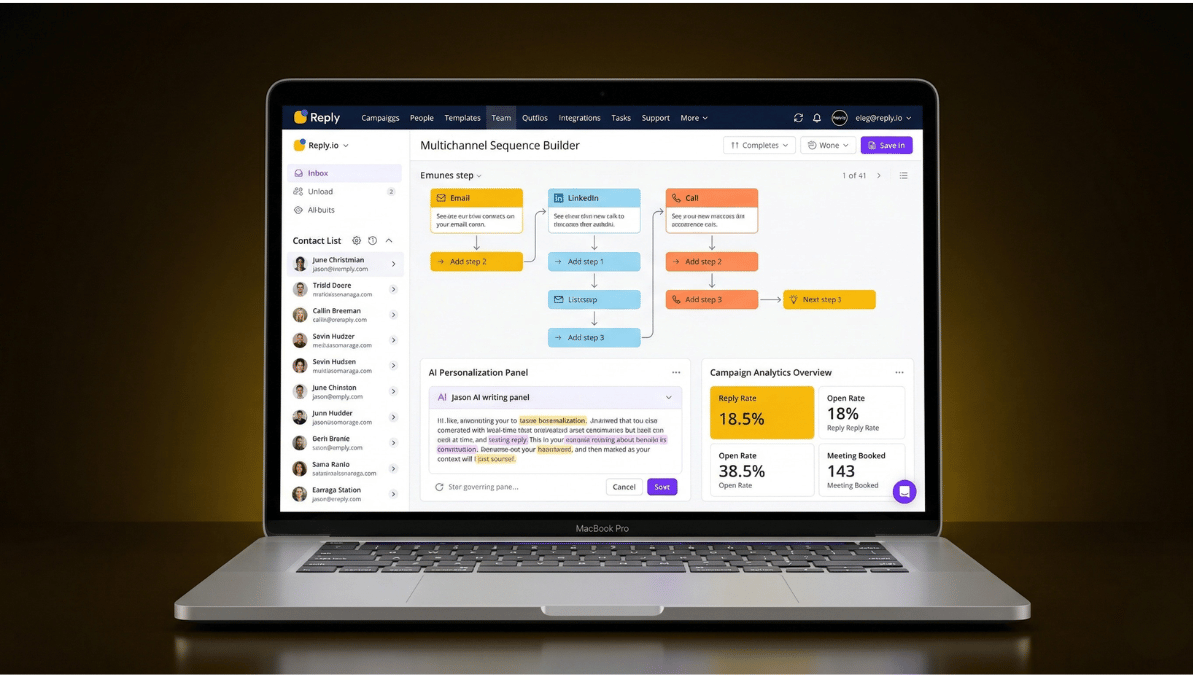
Reply.io’s email sequencing software capabilities are arguably its strongest feature set. Specifically, the visual sequence builder allows complex multi-step cadences across email, LinkedIn, and phone. Moreover, branching logic adapts sequences based on prospect behavior automatically.
🔄 Building Effective Email Sequences
A typical Reply.io sequence might include 5 to 7 touchpoints across multiple channels. For example, day 1 sends an initial cold email. Then, day 3 includes a LinkedIn connection request. Additionally, day 5 fires a personalized follow-up email. Moreover, day 7 triggers a manual phone call task. Finally, day 10 sends a breakup email. As a result, prospects receive coordinated outreach that feels intentional rather than mass-blasted.
Reply.io’s sequence builder includes A/B testing for every step. Specifically, reps test subject lines, send times, message variants, and channel ordering. Moreover, statistical winners promote automatically once meaningful data accumulates. Consequently, sequence performance improves continuously without manual analysis. Additionally, top-performing sequences become templates for the entire team to use.
Reply.io as a Sales Engagement Platform
Beyond cold email, Reply.io functions as a complete sales engagement platform. Specifically, the platform unifies email, LinkedIn, phone, SMS, and WhatsApp outreach in one workflow. Moreover, this multichannel approach significantly outperforms single-channel cold email for B2B outbound.
📱 Multichannel Outreach Capabilities
Reply.io supports five outreach channels natively. First, email automation handles bulk personalized cold email at scale. Second, LinkedIn integration automates connection requests, profile views, and InMail messages. Third, phone integration includes click-to-call dialers with call recording. Fourth, SMS automation sends text messages as part of sequences. Finally, WhatsApp integration extends outreach to international markets where messaging dominates.
📊 Built-in B2B Contact Database
Reply.io includes a built-in B2B contact database alongside its sequencing engine. Specifically, the database contains 140+ million verified business contacts. Moreover, search filters cover industry, role, seniority, and technology stack. As a result, teams can run complete outbound motions without external data tools. However, the database is smaller than dedicated providers like Apollo.io or ZoomInfo. Therefore, teams with specific data depth requirements often pair Reply.io with external contact data sources.
Reply.io Features: Full Breakdown for 2026
Here is every major feature in this Reply.io review. Moreover, each description includes honest detail on what works well and where genuine limitations exist:
🤖 AI and Automation Features
Reply AI Email Generator
Reply AI is the platform’s flagship AI feature. Specifically, the system writes personalized cold emails based on prospect data and company context. Moreover, AI-generated copy references real signals like recent funding, hiring trends, or technology decisions. As a result, generic template blasts become genuinely personalized outreach at scale. Furthermore, reply rates typically improve 2 to 3x compared to manual templates. However, AI quality requires good prospect data inputs to generate high-quality outputs.
Jason AI — AI Sales Development Rep
Jason AI is Reply.io’s AI sales agent that automates entire outbound workflows. Specifically, Jason researches prospects, generates personalized sequences, and books meetings autonomously. Moreover, the AI handles initial conversations and qualifies leads before human handoff. As a result, sales teams scale outbound capacity without proportional headcount growth. Additionally, Jason continuously learns from response patterns to improve over time. However, Jason AI requires careful supervision to maintain message quality and brand consistency.
AI Chat for Inbound Conversion
Reply.io includes AI chat functionality for inbound website conversion. Specifically, the AI handles initial visitor conversations and books meetings automatically. Moreover, qualified leads route directly to appropriate sales reps. As a result, inbound conversion rates improve significantly compared to manual chat handling. Furthermore, the AI integrates with existing Reply.io sequences for follow-up automation.
Smart Sequence Optimization
Reply.io’s optimization engine improves sequences automatically based on performance data. Specifically, the system identifies best-performing send times, message lengths, and channel orderings. Moreover, statistical winners promote automatically once data accumulates. As a result, sequences improve continuously without manual analysis from sales teams. Additionally, optimization extends to A/B testing email subject lines and CTA variations.
📧 Email and Deliverability
Email Warm-Up
Reply.io includes email warm-up tools to build sender reputation gradually. Specifically, the system simulates organic email patterns that ISPs trust. Moreover, warm-up runs automatically in the background without manual effort. As a result, new email accounts ramp up to high sending volumes without triggering spam filters. Additionally, the warm-up tool monitors deliverability metrics continuously and adjusts sending patterns accordingly.
Deliverability Monitoring
Real-time deliverability monitoring tracks inbox placement across major providers. Specifically, the platform tests delivery to Gmail, Outlook, and other primary inbox locations. Moreover, alerts fire when sender reputation drops below safe thresholds. As a result, deliverability problems become visible before they tank entire campaigns. Furthermore, the monitoring dashboard shows historical trends across domains and IP addresses.
Email Personalization Engine
Reply.io’s personalization engine handles dynamic content insertion at scale. Specifically, custom merge fields populate automatically from prospect data. Moreover, conditional logic shows different content based on prospect attributes. As a result, a single template produces hundreds of genuinely personalized variations. Additionally, the engine integrates with AI generation for advanced personalization that goes beyond basic merge fields.
Meeting Scheduler
The built-in meeting scheduler eliminates back-and-forth scheduling friction. Specifically, sequence emails can include calendar booking links automatically. Moreover, the scheduler integrates with Google Calendar, Outlook, and other major calendar tools. As a result, qualified prospects book meetings directly without sales rep intervention. Additionally, the scheduler routes meetings to appropriate reps based on territory or specialization.
🔗 Integrations and Data
CRM Integrations
Reply.io integrates natively with Salesforce, HubSpot, Pipedrive, Copper, and Close. Specifically, data flows bidirectionally between Reply.io and CRM contact records. Moreover, every email sent, opened, and replied logs automatically as CRM activity. As a result, sales managers see complete outbound activity within their existing CRM dashboards. For teams still choosing their CRM platform, our guide on how to choose a CRM for a sales team covers the decision framework.
Reply.io API and Zapier
Reply.io includes API access for custom workflow automation. Specifically, the API supports prospect creation, sequence enrollment, and activity tracking. Moreover, Zapier integration extends connectivity to thousands of additional applications. As a result, teams build custom workflows that match their specific operational requirements. Additionally, webhook triggers fire on key events for real-time downstream automation.
Built-in Dialer and Call Recording
Reply.io includes a native dialer for outbound calling within sequences. Specifically, click-to-call functionality eliminates manual phone number copying. Moreover, automatic call recording captures every conversation for review and coaching. Additionally, call dispositions log automatically to track outcomes. As a result, sales managers have complete activity visibility without separate dialer subscriptions.
Reply.io Pricing 2026: Every Plan Explained
Reply.io pricing is structured across multiple plan tiers to match different team sizes and requirements. Specifically, plans differ based on user seats, contact volumes, and AI feature access. Moreover, understanding the plan structure is essential before choosing the right tier:
Free
$0/mo
No credit card · Up to 200 contacts
Includes 200 active contacts, basic sequencing, email warm-up, and Chrome extension. Moreover, basic CRM integration is included. However, AI features and advanced sequencing require paid plans. As a result, the free plan validates Reply.io for small teams. Specifically, 200 active contacts genuinely test the platform with real workflows.
Email Volume
$59/user/mo
Billed annually · 1,000 contacts/user
Includes everything in Free plus AI-powered email writing and unlimited mailboxes. Additionally, advanced sequencing with branching logic and A/B testing unlocks. Moreover, deliverability monitoring tools become available. Consequently, this plan suits teams running serious email-only outbound campaigns. Therefore, it is the right starting point for email-focused sales motions.
Multichannel
$99/user/mo
Billed annually · Email + LinkedIn + Calls
Includes everything in Email Volume plus LinkedIn automation, call dialer, and SMS. Additionally, all multichannel sequence steps unlock. Moreover, advanced reporting and team analytics become available. As a result, this is Reply.io’s flagship plan for serious B2B outbound teams. Consequently, most established sales teams land on this tier for complete multichannel capability.
Agency
$210/mo
Billed annually · Multi-client management
Includes everything in Multichannel plus client management features for agencies. Specifically, white-label reporting, multi-workspace management, and dedicated support unlock. Moreover, agencies can manage outbound campaigns for multiple clients from one account. Additionally, custom branding maintains the agency’s identity in client-facing materials.
Which Reply.io Plan Should You Choose?
For most teams evaluating Reply.io pricing, the path is clear. First, try the free plan to validate the platform against your workflow. Then, upgrade to Email Volume ($59/user/mo) for email-only outbound motions. Moreover, established teams running multichannel outbound should choose Multichannel ($99/user/mo) for complete capability. Finally, only choose Agency ($210/mo) if you manage outbound for multiple clients. Start free at get.reply.io/DemoStack.
Run multichannel outbound campaigns that convert
Join 30,000+ sales professionals using Reply.io for AI-powered cold email and sequencing.
Reply.io Review: Honest Pros and Cons
This honest Reply.io review section covers both the genuine strengths and the real limitations. Specifically, the analysis draws from verified user reviews across G2, Capterra, and TrustRadius:
✅ Where Reply.io Delivers
- Best-in-class email sequencing with sophisticated branching logic
- AI email generation produces 2-3x higher reply rates than templates
- Jason AI handles complete outbound workflows autonomously
- Multichannel outreach across email, LinkedIn, calls, SMS, and WhatsApp
- Built-in email warm-up and deliverability monitoring
- 140+ million B2B contact database included on paid plans
- Native dialer with automatic call recording
- Native CRM integrations with Salesforce, HubSpot, Pipedrive, and Copper
- API access on all paid plans for custom workflow automation
- Free plan available to validate the platform before paying
- 4.6/5 on G2 from 1,400+ verified reviews — reliable performance
- 30,000+ users and 3,000+ B2B customers worldwide
- Strong agency tier for multi-client management
❌ Where Reply.io Falls Short
- Built-in B2B contact database is smaller than Apollo.io or ZoomInfo
- Multichannel plan at $99/user/month is more expensive than Apollo.io’s $49 Basic
- AI features require higher-tier plans for full capability
- Learning curve steeper than basic email sequencers like Mailshake
- LinkedIn automation requires careful use to avoid platform penalties
- Customer support response times variable on lower-tier plans
- UI can feel busy with so many channels and features
- Some reports of occasional delivery issues with shared IP pools
- Free plan limited to 200 active contacts — not enough for active sales teams
Reply.io vs Outreach: Specialist vs Enterprise
The Reply.io vs Outreach comparison is a common decision point for sales teams. Specifically, both platforms offer sales engagement capabilities but target different markets. Here is the honest side-by-side comparison:
🎯 When Reply.io Wins Over Outreach
Reply.io wins on price, AI features, and specialist multichannel sophistication. Specifically, Reply.io starts free while Outreach requires enterprise contracts. Moreover, Reply.io’s AI personalization is meaningfully more advanced than Outreach’s basic templating. Additionally, Reply.io’s built-in B2B database eliminates a separate data subscription. As a result, lean outbound teams typically prefer Reply.io for total cost and capability.
🏢 When Outreach Wins Over Reply.io
Outreach wins on enterprise features, advanced reporting, and Salesforce-native architecture. Specifically, Outreach was built specifically for enterprise sales orgs with complex governance requirements. Moreover, the platform’s reporting infrastructure is more sophisticated for sales operations teams. Therefore, enterprise teams with 50+ reps and Salesforce-centric workflows often choose Outreach despite the higher cost.
Reply.io vs Apollo: Specialist Sequencing vs All-in-One
The Reply.io vs Apollo comparison comes down to architecture preferences. Specifically, Apollo.io is an all-in-one platform combining contact data and sequencing. In contrast, Reply.io is a specialist sequencing tool requiring external data sources. Therefore, the choice depends on whether you prioritize all-in-one simplicity or best-in-class sequencing.
| Feature | Reply.io | Apollo.io | Lusha | Outreach |
|---|---|---|---|---|
| Starting Price | Free / $59 | Free / $49 | Free / $36 | $100+/user/mo |
| Sequence Sophistication | Best in class | Strong | ✗ | Best in class |
| Built-in Contact Database | 140M+ (smaller) | 275M+ | 150M+ | ✗ |
| AI Email Generation | Reply AI + Jason | Higher tiers | ✗ | Limited |
| Multichannel (Email + LI + SMS + WhatsApp) | 5 channels | 3 channels | ✗ | 3 channels |
| Built-in Dialer | ✓ | Higher tiers | ✗ | ✓ |
| CRM Integrations | ✓ All major | ✓ All major | ✓ All major | ✓ Salesforce-native |
| G2 Rating | 4.6/5 (1,400+) | 4.7/5 (8,500+) | 4.3/5 | 4.3/5 |
| Best For | Specialist sequencing | All-in-one SMB | LinkedIn prospecting | Enterprise |
Reply.io vs Apollo: The Verdict
Apollo.io wins on database size, all-in-one simplicity, and total cost. Specifically, Apollo offers 275M contacts plus sequencing for $49/user/mo. In contrast, Reply.io’s $99 Multichannel plan plus a separate data tool can cost more total. However, Reply.io wins on sequencing sophistication and AI capabilities. Therefore, choose Apollo.io if you want one platform covering everything. Alternatively, choose Reply.io if you already have contact data and need best-in-class sequencing. Read our full Apollo.io review for detailed comparison.
Reply.io Alternatives: When to Choose a Different Platform
Reply.io is the right choice for specific use cases. However, Reply.io alternatives serve different priorities better. Here are the strongest alternatives worth considering:
🏆 Apollo.io — The Best All-in-One Alternative
Apollo.io is the strongest Reply.io alternative for teams that want database plus sequencing in one subscription. Specifically, Apollo offers 275M contacts and full sequencing starting at $49/user/mo. Moreover, the all-in-one architecture eliminates the need for separate data subscriptions. As a result, total stack cost is typically lower than Reply.io plus a data tool. Read our full Apollo.io review for detailed evaluation.
🎯 Lusha — For LinkedIn-First Teams
Lusha is the right Reply.io alternative when LinkedIn prospecting drives outbound. Specifically, Lusha’s Chrome extension surfaces verified contacts directly on LinkedIn profiles. Moreover, direct dial accuracy consistently rates highest in independent reviews. However, Lusha lacks native sequencing entirely. Therefore, teams pair Lusha with Reply.io as a specialist sequencer. Read our Lusha review for complete details.
🏢 ZoomInfo — For Enterprise Teams
ZoomInfo is the right Reply.io alternative for enterprise teams with budget for enterprise-grade contact data. Specifically, ZoomInfo offers superior intent data and EMEA coverage. Moreover, enterprise compliance certifications (SOC 2, HIPAA, ISO 27001) are non-negotiable for regulated industries. However, ZoomInfo starts at $15,000+ annually. Therefore, smaller teams should evaluate Apollo.io or Reply.io instead. Read our ZoomInfo review for detailed enterprise comparison.
Pairing Reply.io With Inbound Attribution Tools
Reply.io handles outbound sales engagement. However, complete sales teams also track inbound leads from marketing campaigns. Consequently, pairing Reply.io with inbound attribution creates a complete pipeline picture.
🎯 Call Tracking for Marketing Attribution
For teams running paid media campaigns, inbound calls represent significant revenue. Specifically, call tracking software attributes each inbound call to its marketing source. Moreover, our CallRail review covers the leading platform for this. As a result, sales teams see complete attribution across outbound (Reply.io) and inbound (CallRail) channels. Therefore, this architecture delivers full-funnel visibility from marketing investment to closed revenue.
🏆 Reply.io Review 2026: Our Final Verdict
Based on this complete Reply.io review, Reply.io earns a strong recommendation as one of the best cold email software platforms for B2B sales teams. Specifically, the combination of AI-powered sequencing, multichannel outreach, and built-in deliverability tools makes it the strongest specialist sequencing platform in 2026. Moreover, the 4.6/5 G2 rating from 1,400+ verified reviews confirms real-world performance matches platform capabilities.
⚠️ Honest Limitations to Consider
However, several limitations deserve attention. First, Reply.io’s built-in B2B database is smaller than Apollo.io and ZoomInfo. Second, multichannel pricing at $99/user/mo is higher than Apollo.io’s $49 Basic plan. Third, advanced AI features require higher-tier subscriptions. Nevertheless, for teams prioritizing sequencing sophistication over database size, Reply.io delivers genuine value.
🎯 Recommended Path Forward
For most teams evaluating Reply.io, the recommended path is clear. First, start with the free plan to validate the platform against your workflow. Then, upgrade to Email Volume at $59/user/mo for email-only outbound. Finally, move to Multichannel at $99/user/mo when LinkedIn, calls, and SMS become essential. Consequently, this progression matches investment to outbound complexity gradually.
✅ Reply.io is right for you if:
- You need best-in-class email sequencing with branching logic
- You run multichannel outbound combining email, LinkedIn, calls, SMS
- You want AI-powered email personalization that improves reply rates
- You already have contact data from Lusha, ZoomInfo, or another source
- You run an agency managing outbound for multiple clients
- You need a free plan to validate before paying
⚠️ Consider alternatives if:
- You want database plus sequencing in one platform (choose Apollo.io)
- LinkedIn prospecting is your primary motion (choose Lusha)
- You need enterprise compliance certifications (choose ZoomInfo)
- Your budget is below $59/user/mo for active outbound
- You only need basic email sequencing (consider Mailshake or Lemlist)
Start Your Reply.io Free Trial Today
Join 30,000+ sales professionals using Reply.io for AI-powered cold email and multichannel outbound.
Free · Email Volume from $59/user/mo · Multichannel from $99/user/mo · Agency from $210/mo